


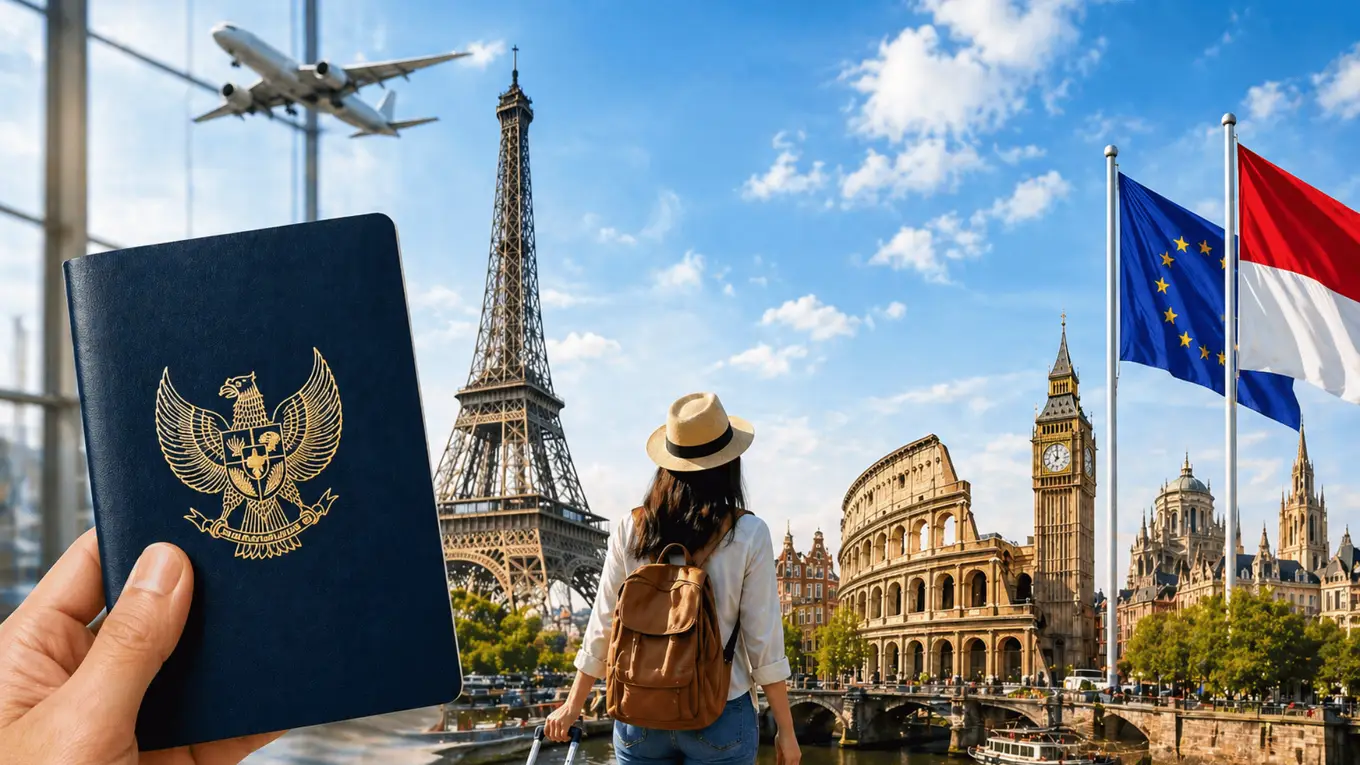

New Policy: Five-Year Schengen Visa Could Make Europe More Accessible for Indonesians
For many Indonesian travelers, visiting Europe has always been both exciting and complicated. On one hand, Europe remains a dream destination for tourists, business professionals, students, and frequent international travelers. On the other hand, repeatedly applying for visas can be time-consuming and frustrating.
That situation may soon begin to change.
Indonesian citizens could soon benefit from easier access to Europe through the implementation of the Schengen Visa Cascade, a policy that allows travelers to obtain multiple-entry visas valid for up to five years.
If fully implemented, this policy could significantly improve mobility between Indonesia and Europe.
It also reflects a broader strengthening of economic ties between Indonesia and the European Union.
What Is the Schengen Visa Cascade?
The Schengen Visa Cascade is a step-by-step visa mechanism that allows travelers to receive longer visa validity periods based on their previous travel history.
First-time applicants may still receive short-term visas.
However, travelers with strong travel records and a history of complying with visa regulations may become eligible for longer multiple-entry visas.
In some cases, visa validity could extend up to five years.
This system is designed to reduce repetitive administrative processes for frequent travelers to Schengen countries.
Traveling to Europe Could Become More Flexible
For Indonesian travelers, this policy could offer significant practical advantages.
Tourists would no longer need to repeatedly apply for visas for short trips.
Business travelers could move more efficiently between countries.
Students and professionals may also gain easier access to conferences, academic programs, and international networking opportunities.
With fewer administrative barriers, Europe could become far more accessible for Indonesians.
The Role of IEU-CEPA
This visa development is also closely connected to broader economic discussions between Indonesia and the European Union through the Indonesia-European Union Comprehensive Economic Partnership Agreement (IEU-CEPA).
Under the agreement, the European Union is expected to liberalize around 98.61 percent of tariff lines for Indonesian products.
This could potentially boost Indonesian exports, attract foreign investment, improve business mobility, and strengthen tourism growth.
Visa accessibility plays an important role in supporting stronger regional connectivity.
Positive Impact on the Travel Industry
If implemented successfully, the travel industry could benefit significantly.
Travel agencies may offer more European travel packages.
Airlines could experience higher demand for international routes.
Business travel, MICE tourism, and long-term travel planning may also grow.
Popular destinations such as France, Italy, the Netherlands, Germany, and Spain are expected to attract even more Indonesian travelers.
What Travelers Should Prepare
Although this policy presents major opportunities, travelers still need to prepare properly.
Valid passports, financial documentation, travel insurance, clear travel purposes, and strong visa compliance records will remain important factors.
Greater accessibility still comes with responsibility.
A New Era of Global Mobility for Indonesians
A five-year multiple-entry Schengen visa could become a major breakthrough for Indonesian global mobility.
It would not only simplify leisure travel but could also strengthen education opportunities, business relationships, and economic cooperation between Indonesia and Europe.
For Indonesian travelers, Europe may soon feel much closer—and far easier to reach than ever before.
Footnotes
1 Schengen Visa Cascade implementation discussion under IEU‑CEPA
2 EU tariff liberalization of 98.61% for Indonesian goods
3 Tourism and business mobility projections between Indonesia and Europe